Fostering Employment
A strong approach for rural villages in Sri Lanka’s Northern and Eastern Provinces is to shift from relief dependency to a self-resilience recovery mechanism.
Description
The restoration of economic recovery is treated as “village-level economic rebuilding”.
That means every intervention should move households through five steps:
income stabilisation, asset rebuilding, skills upgrading, market connection, and risk protection.
This matters because Sri Lanka’s rural economy is dominated by low-productivity and informal work, while women and youth face especially weak access to decent employment.
In 2023, rural Sri Lanka had a labour-force participation rate of 49.1 per cent, female labour-force participation was only 31.3 per cent nationally, youth unemployment was 23.0 per cent, and 58.0 percent of employment was informal. Department of Census and Statistics, Sri Lanka.
Why do the North and East need a different model?
The North and East are not only poor; they are structurally vulnerable. The World Bank’s assessment of conflict-affected Northern and Eastern provinces highlights damaged roads and services, weakened social networks, land access problems, skills mismatch, low female participation, psychosocial distress, and limited private investment. In these provinces, recovery cannot rely only on cash transfers or isolated training workshops; it must rebuild the local economy and social fabric at the same time.
What “self-resilience recovery mechanism” should look like
Below is a practical model for village transformation.
| Stage | What happens | What changes for households |
| 1. Recovery-to-work | Short-term paid work restores irrigation channels, farm roads, tanks, landing sites, and storage sheds | Families earn immediately without long-term dependency |
| 2. Productive asset restart | Inputs, tools, livestock, fingerlings, seedlings, nets, small machinery, solar drying or cold-chain equipment are given through producer groups | Aid turns into income-producing assets |
| 3. Skills and certification | Farmers, fishers, women, and youth receive technical training, business coaching, and recognition of prior learning | Workers become employable, and productivity rises |
| 4. Market linkage | Cooperatives/FPOs sign buyer agreements, aggregate output, improve quality, branding, processing, and transport | Villages sell into stable markets instead of distress-selling |
| 5. Resilience finance | Savings groups, revolving funds, crop/fishery, emergency reserves, and climate advisories are embedded locally | Households can absorb shocks without falling back into dependence |
This strategy will fail if women and youth are treated as “beneficiary categories” rather than primary economic actors. Female labour-force participation in Sri Lanka remains low, and youth unemployment is high. In the conflict-affected North and East, the constraints are sharper due to care burdens, insecurity, limited mobility, and social norms.
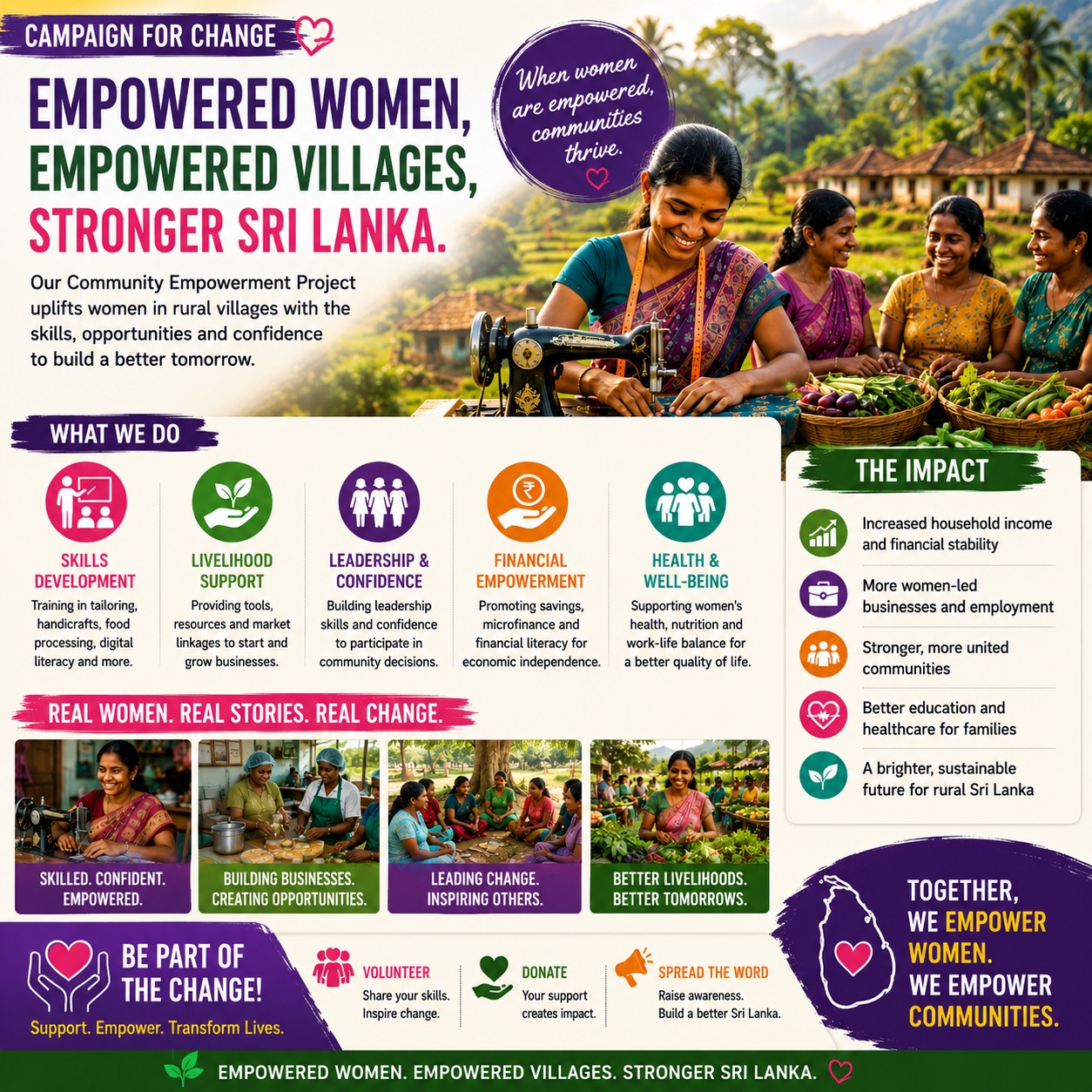
To foster employment in rural villages of Northern and Eastern Sri Lanka, the best model pledge is to adapt “aid plus training.” It is a local economic system rebuilding.
By restoring productive infrastructure, organising producers, creating village enterprises around agriculture and fisheries, connecting them to real buyers, and building local resilience finance so that the next drought, flood, or price shock does not push households back into dependence.
That is how dependency changes into self-resilience.
Creating a Driven Ecosystem
Top-down development often feels disconnected from the actual needs of the people. Grassroots community support ensures that projects are built by the community and for the community. When local people are actively engaged, it builds a sense of collective ownership. This shared responsibility turns a simple project into a driving force capable of collaborating effectively with regional development bodies, industry groups, and decision-makers. Real, sustainable progress is never a solo endeavour. It requires a dedicated network willing to step up precisely when it matters most, ensuring that vital local initiatives have the runway they need to achieve independence.
No one builds anything meaningful entirely on their own; it always takes a dedicated willingness to step up precisely when it matters most to provide that necessary runway. Partner with Pldge to build sustainable models and have the foresight to seed a project, fund its initial phases, and guide it until the local structure can take ownership and run on its own.